Thursday, October 21, 2010

Opportunistic Science

The other night my husband came home from work with some dry ice used to ship some temperature-sensitive electronics to his workplace. A true homeschooling father, he couldn't believe that his coworkers were not equally eager to make off with as much dry ice as possible in order to educate and entertain their own kids.

So the payload was all his. He came home to find not only our own kids, but another homeschooled neighbor enthusiastically ready to behold the wonders of sublimation. Dry ice skittered across the counter. Spoons screamed. Mad scientist brews were made. Bubble worms emerged from bottles. Bottles were made to blow their tops. Laser pointers put on a show in swirls of carbon dioxide.

My daughter emphatically declared that her father should be employed by the science center where she takes monthly homeshcool science classes.

Unfortunately, I don't think that gig will pay the bills.

Sunday, September 19, 2010

Lapbooks

"Lapbooks" are a popular trend among many homeschoolers. Apparently these folder-projects are called such because they are a "book" that fits in one's "lap"

I personally find the term a bit peculiar (don't all books fit in one's lap?), and around our home, we simply use the term "project", but no matter what you call them, they are fun way to break up the routine. While I do reject a lot of the project frenzy of public school, I do think it is valuable for my homeschooled children to have the experience of making a plan, manipulating materials, and assembling a project as a completed product.

Some lapbooks, like the one pictured above, are made from templates. I find this particularly useful for my 2nd grader, as it gives her a starting point. The templates also provide her with guidelines that prompt good questions to ask about the subject, in this case, literature, such as the nature of conflict and change in a given story. Activities can be included in the lapbook as well that prompt the child to become familiar with using a book's index, glossary, and table of contents.

The above templates were made freely available at homeschoolshare.com.

Tuesday, September 14, 2010

An American Girl Review

For my 2nd grader's social science curriculum this year, we have opted to use the series of juvenile historical fiction, the American Girl books. At first I went into this rather blindly, knowing only that my daughter had an interest in reading the books, and confirming with the children's librarian that the books were historically accurate. But beyond that, I've been pleased beyond all expectation. The books are not only accurate, but are told enchantingly from the perspective of a nine-year-old girl in each series. We chose to begin chronologically, with Kaya, the Nimiipuu (Nez Perce) girl, moving on to Felicity of the colonial era, and so on.


What I really like is the history is handled in a very well-rounded way without being eye-rollingly politically correct. The books cover some of the shameful parts of American history, and also the stuff we're proud of - but it also shows how much of it is really a mixed bag. All the books (at least the ones we've read so far) have an ongoing theme of change - what is changing in the big picture - America - as well as what is changing in a girl's life at 9-10 yrs old in terms of relationships, desires, growth, etc. Some have other themes as well, such as liberty in the first Felicity book, in the background we start to hear about the start of the American Revolution, but more central in Felicity's life is her efforts to liberate a horse from an abusive neighbor, even though she has to break some rules to do so. The character in the next book becomes best friends with a girl who is from a Loyalist family, while her own is high profile Patriot family, and to some extent we see both sides of even THAT story, that is generally treated fairly one-sided in American schools. The books neither beat-up on America nor paint it as an infallible entity.

All the parents in the books that I've seen so far have opinions and explain their views to their daughter, but ultimately respect their daughter making her own choices. And the girls all so far respect their parents, even if they at times break rules or push boundaries.

I've also loved the way the books treat female roles. In every book so far we've seen a very accurate historical account of what a female role would be historically. Two things come out of that - the girl or other female characters either by choice or circumstance break out of that role (in a believable way), while at the same time the "traditional" women in the book are depicted as equally strong and capable women who contribute a great deal to their communities and families, and worthy of respect.

The girls themselves are strong, spiritual, kind, and competent. They have the appropriate failures of a child and of a human being, but the reader really gets a strong sense of how much burden and responsibility that girls were once expected to have. They developed real skills. In some ways, we are shown how people in history respected children more than they do now. Even in a society where women did not have equal rights and children were "seen and not heard", these girls were expected to be competent, capable, articulate, and to contribute to their communities in vital ways.

Wednesday, August 25, 2010

Junior Ranger Program

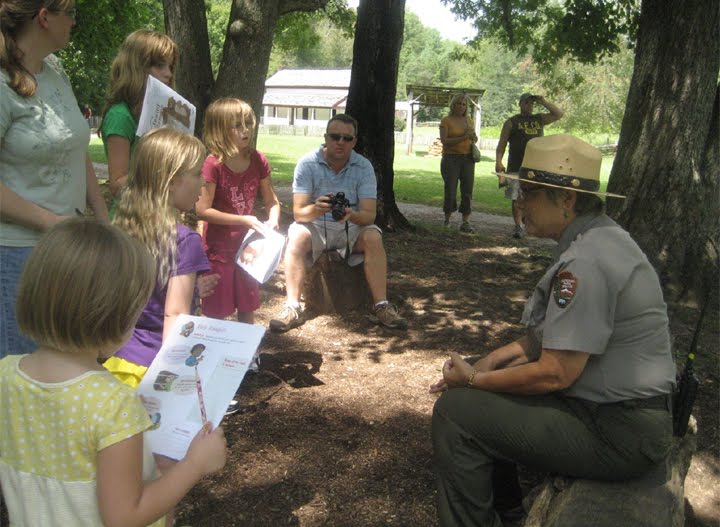
Last week, we joined another homeschooling family for a fun-filled family vacation to the Great Smoky Mountains. While there, all four of our girls (ages 5, 6, 7, and 10) became "Junior Rangers" by participating in Junior Ranger Program. The program is designed for children ages 5-12, divided into four age groups: 5-6, 7-8, 9-10, and 11-12, and is available at most national parks and recreation areas. Some states sponsor similar programs at state parks as well.

Participation begins with the purchase of a Junior Ranger Handbook ($2.50 at Great Smoky Mountains National Park). The child must complete several steps, including participation in a ranger-lead program, one bag of litter pickup in the park, and the completion of eight out of twelve age-appropriate activities in their book. Some activities require travel and observation in the park, while others require interviewing a ranger. There are also a few are easier "filler" activities that can be done during downtime with just a pencil. Activities included things like leaf identification, learning about the meaning behind the Park Ranger badge, and going on a nature scavenger hunt.

The girls get a private session with Ranger Mary Jo at Cades
Cove in Great Smoky Mountains National Park.
Properly completing all the activities takes some time. We spent three half-days in the park in order to complete the whole program, which included visits to three major areas in Great Smoky Mountains National Park (Clingmans Dome, Laurel Falls, and Cades Cove). Some activities we were unable to complete as they required visits to alternate areas, but with those three areas we managed to complete the necessary requirements. Completion results in recognition from a park ranger, the swearing of the Junior Ranger oath, and the child is given a certificate and plastic badge.

I'll be honest - with the exception of the enthusiastic youngest, most of the kids were in general, lukewarm about completing the program, but they all definitely learned something, and the program inspired us to have more focus and direction as we toured the park. The kids' participation definitely opened the door to direct personal educational interaction with rangers, and there were moments of enthusiasm for all four of the kids, even if they were a little dismissive about some of the less-exciting paperwork-type activities. I felt the activities were just challenging enough for each age group - requiring some effort from the kids without being dauntingly difficult for a short stay in the park. It would be challenging to legitimately finish the program during a single day in the park (especially if you are facing some inclement weather, as we did), but a 2-3 day visit should be sufficient.

Thursday, August 12, 2010

Renewbot - Your Library Hero

If you're like many homeschoolers, you use the public library.

A lot.

Most "normal" people might hear the library check-out limit of twenty or thirty books and think (as I once did) - That's crazy! Why would anyone EVER need to check out so many books?

Well consider children's novels (thirty-minute reads) and early readers for two kids, resource books, research materials, along with anything I want to check out for myself as long as I'm there, and the list adds up quickly.

I am so intimately familiar with multiple branches of the Madison County Public Library, that I've come to think of it as the poor-man's public school. There's a father with two children that I see homeschooling his two children at the downtown main branch so often, I nod at him in recognition. The youth librarian knows who I am, and I've given up on using my childrens' library cards. After a point, the multiple library cards just complicates things.

I can't claim to be the most "on it" person, so on more than one occasion I've handed over hefty fines the library. I've been at peace with it, since I imagine the library needs the financial support, but my husband hasn't been exactly thrilled with handing over a sizable check for books we don't even get to keep.

Enter RenewBot - Your Library Hero! I was alerted to RenewBot by fellow blogger, homeschooler, and forum-buddy Beckie from Spookiez Spot. I've been using it for a while now and let me be the first to say, this tool is amazing. It not only automatically renews my books two days before they are due, but e-mails me if the books are nonrenewable, either because  of a hold or because I've exceeded the allotted number of renewals. Additionally, when I request holds, RenewBot emails me when the holds are processed and awaiting me at the library of my choice.

RenewBot is compatible with many libraries nationwide. I highly recommend it. I only lament that the site probably will cause a large loss of revenue for the public library. I may still have to make a donation at the end of the year, just to balance my karma.

Monday, August 9, 2010

The First Day of School

Today marks the first day of school for Huntsville City Schools, and though as a homeschooling family we have no need to follow a traditional school calendar, it is in many ways a "first" for us, too. The first day of the season with no summer activities, lemonade stands, or knocks on the door.

This summer was my first summer as a homeschooling mom. As a homeschool educator, it doesn't take long to learn why school curricula are so repetitive, or why schools and teachers like to emphasize summer reading lists and mathematics practice. Kids can lose their momentum fast, and it doesn't take long before you find yourself needing to review previously mastered material. As damage control, I decided to continue homeschooling through the summer.

However, I also made it a conscious policy not to let my plans to homeschool through the summer interfere with any summer fun enjoyed by friends and neighbors in public or private school. Aside from all the fabulous summer camp opportunities that I feel are especially beneficial to my home-educated children, I'm fortunate to live in a hopping neighborhood with a high population of schoolchildren.

Needless to say, our "homeschooling" this summer ended up being reduced to 1-2 hours a day, if that. By mid-July, I had pretty much given up, and kept it simple with basic math drills and reading.

The start of the public school calendar for us rang in a new school year as well. Calendars were made, and posted. Folders were organized, and we even purchased a brand-new bookcase designated for our school materials. Even a first-day-of-school-picture was taken.

Happy schooling!

Thursday, June 24, 2010

Weapons, Religion, and Public School Policy

Some of you are no doubt familiar with the story last week of a Rhode Island public school banning the hat of second-grader David Morales. In order to participate in the school's "crazy hat day", David had decorated an army-themed hat with little plastic toy army men. The school banned the hat due to the school's zero-tolerance policy for weapons, because the toy soldiers were carrying tiny plastic military rifles.
When we read a story like this, it is easy to dismiss it as the rare insanity of an errant administrator. Surely this kind of decision-making is not common in public schools?

I myself was the victim of a bizarre public school ruling when my daughter attended public school in Kindergarten. Sensitive to the fact that my daughter was one of the few Jewish children attending her public school in Alabama, I asked her teacher if I could come into the classroom to share a bit about one or more Jewish holidays. I assured her up front that everything discussed would be in an age-appropriate, secular/cultural context. I also offered her a choice of several holidays, including Rosh Hashanah, the Jewish New Year, which could have easily been reduced down to a brief lesson on different calendar systems and the sharing of some cultural items and foods.

Her teacher, however, did not feel comfortable with me bringing any remotely religious content into the classroom. After some discourse, I decided to drop the matter, out of respect for the school's desire to maintain a secular environment, as much as I disagreed.

Yet that December, I found my daughter utterly inundated with Christmas imagery and symbols. Truly, I had no problem with this aside from the utter hypocrisy of having Jewish celebrations banned from this classroom while my daughter remained exposed to Christmas revelry unabated. Still, understanding that Christmas is for a large portion of society a secular celebration, I remained silent until I saw the schedule called for a viewing of "A Charlie Brown Christmas."

Now, I love Charlie Brown. I love the Christmas special. It's classic, and I have no issue with my children being exposed to this endearing piece of 20th century American culture. But the show has an undeniable Christian message, with Linus getting up on stage and telling the miraculous story of the birth of Jesus Christ.

I contacted the teacher and emphasized up front that I had absolutely no objection to this film being shown to my child, but that considering the religious content and the constant exposure to Christmas imagery, I could see no reasonable objection to me coming in and reading a Hanukkah counting book to Kindergarteners and letting them spin some dreidels.

After much hemming and hawing, the teacher did eventually permit me to come in and present some non-religious Hanukkah items. She also, much to my great objection and regret, cancelled the viewing of "A Charlie Brown Christmas."


This is the tragedy of the modern American classroom, which is increasingly becoming devoid of common sense. This is the tragedy of the American public, that has grown so hypersensitive, it demands an emotionally and intellectually sterile environment for its children. No one group, I think, is devoid of guilt in this phenomenon; the pacifist that is offended by army men, the Jew that is offended by the Christmas tree or Easter flowers, the Christian that is offended by Harry Potter books or paperboard witches at Halloween. The family with no mothers and/or fathers that wrings hands over the potential trauma of their child having to endure a Mother's or Father's Day activity. Health awareness has even put a stop to the sharing of birthday treats at many schools, and recess is increasingly being replaced by structured physical education activities.

It is without end. What began as an attempt to expand diversity in the classroom is rapidly transforming into something that excludes all practical diversity in favor a secular, predictable, safety-sealed educational experience.